
Search
Search results for
We found
11 results for you
-

Intra-regional translocations of epifaunal and infaunal species associated with cultured Pacific oysters Crassostrea gigas
Item type: Journal Article • Journal: African Journal of Marine Science • Authors: TM Haupt --- Centre for Invasion Biology and Marine Biology Research Centre, South Africa CL Griffiths --- Centre for Invasion Biology and Marine Biology Research Centre, South Africa TB Robinson --- Centre for Invasion Biology and Marine Biology Research Centre, South AfricaFarmed oysters host a diverse community of epifaunal and infaunal fouling taxa, including alien species, and these are easily translocated in the course of commercial oyster trade. We document the diversity and densities of fouling taxa associated with farmed oysters... -
Confirmed identification of gymnodimine in oysters from the west coast of South Africa by liquid chromatography–tandem mass spectrometry
Item type: Journal Article • Journal: African Journal of Marine Science • Authors: B Krock GC Pitcher J Ntuli AD CembellaMussels Choromytilus meridionalis and oysters Crassostrea gigas were suspended from a mooring off Lambert's Bay, South Africa, to study the kinetics of lipophilic phycotoxin accumulation and detoxification. The shellfish were subsequently harvested daily over approximately three weeks and analysed for... -
Introduced Pacific oysters Crassostrea gigas in South Africa: demographic change, genetic diversity and body condition
Item type: Journal Article • Journal: African Journal of Marine Science • Authors: J Keightley --- Department of Botany and Zoology, South Africa S von der Heyden --- Department of Botany and Zoology, South Africa S Jackson --- Department of Botany and Zoology, South AfricaSuccessful aquaculture species are often chosen for their fast growth rates and fecundity, which are also characteristics of invasive species. The Pacific oyster Crassostrea gigas, which constitutes 80% of global oyster trade, has been confirmed as invasive in 17 of... -
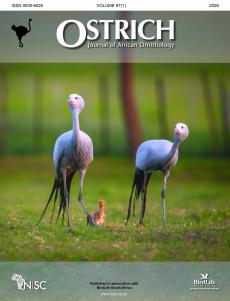
Trends in African Black Oystercatcher Haematopus moquini populations between the early 1980s and early 2000s, with consideration of the influence of protected habitats and food availability
Item type: Journal Article • Journal: Ostrich: Journal of African Ornithology • Authors: Douglas Loewenthal --- Percy FitzPatrick Institute of African Ornithology, DST–NRF Centre of Excellence, South Africa Dane M Paijmans --- Percy FitzPatrick Institute of African Ornithology, DST–NRF Centre of Excellence, South Africa Philip W Haupt --- Seychelles Islands Foundation, Republic of Seychelles Philip AR Hockey --- Percy FitzPatrick Institute of African Ornithology, DST–NRF Centre of Excellence, South AfricaThe African Black Oystercatcher Haematopus moquini is classified as Near Threatened because the population size is small (<10 000) and numbers have decreased or were previously recorded as decreasing. Although human activity has increased in many parts of the species’... -
Differential reactions to anthropogenic disturbance by two ground-nesting shorebirds
Item type: Journal Article • Journal: Ostrich: Journal of African Ornithology • Authors: Shirley Van de Voorde --- Van Hall Larenstein, The Netherlands Minke Witteveen --- Percy FitzPatrick Institute of African Ornithology, DST–NRF Centre of Excellence, South Africa Mark Brown --- School of Life Sciences, South AfricaMany ground-nesting shorebirds experience a high level of anthropogenic disturbance, often to the detriment of their breeding success. This study investigated the responses of the Near-Threatened African Black Oystercatcher Haematopus moquini (ABO) and the Least Concern Kelp Gull Larus dominicanus... -
Temporal and spatial differences in three-egg clutch frequency of the African Black Oystercatcher
Item type: Journal Article • Journal: Ostrich: Journal of African Ornithology • Authors: Dane M Paijmans --- Percy FitzPatrick Institute of African Ornithology, DST–NRF Centre of Excellence, South Africa Douglas Loewenthal --- , Peter G Ryan --- Percy FitzPatrick Institute of African Ornithology, DST–NRF Centre of Excellence, South Africa Philip AR Hockey --- ,African Black Oystercatchers Haematopus moquini produce a modal clutch size of two eggs and only rarely lay three eggs. A review of over 4 000 nest records from across their breeding range (dating back to the early 1960s) revealed that... -

Oysters as vectors of marine aliens, with notes on four introduced species associated with oyster farming in South Africa
Item type: Journal Article • Journal: African Zoology • Authors: T.M. Haupt --- Centre for Invasion Biology and Marine Biology Research Centre, South Africa C.L. Griffiths --- Centre for Invasion Biology and Marine Biology Research Centre, South Africa T.B. Robinson --- Centre for Invasion Biology and Marine Biology Research Centre, South Africa A.F.G. Tonin --- Striker Fishing (Pty) Ltd, South AfricaTranslocated oysters are well known to act as vectors of marine alien species, but to date this topic has received scant attention in South Africa, despite the fact that oysters have been imported into this region since 1894. Surveys of... -
Saldanha Bay, South Africa III: new production and carrying capacity for bivalve aquaculture
Item type: Journal Article • Journal: African Journal of Marine Science • Authors: TA Probyn --- Aquaculture Research, Department of Agriculture, Forestry and Fisheries, South Africa JF Atkins --- Department of Oceanography, South Africa GC Pitcher --- Aquaculture Research, Department of Agriculture, Forestry and Fisheries, South AfricaMeasurements of NH4, NO3, urea and HCO3 uptake using 15N and 13C stable isotope tracers were undertaken in Saldanha Bay, South Africa, between January 2012 and January 2013. These studies provide the first direct measurements of N utilisation by the... -
Sustainable shellfish aquaculture in Saldanha Bay, South Africa
Item type: Journal Article • Journal: African Journal of Marine Science • Authors: A Santa Marta --- , United Kingdom JG Ferreira --- , United Kingdom GC Pitcher --- , South Africa J Lencart e Silva --- , United KingdomThe carrying capacity for bivalve shellfish culture in Saldanha Bay, South Africa, was analysed through the application of the well-tested EcoWin ecological model, in order to simulate key ecosystem variables. The model was set up using: (i) oceanographic and water-quality... -
Effect of rotational harvesting on the size composition of Cape rock oysters Striostrea margaritacea on the east coast of South Africa
Item type: Journal Article • Journal: African Journal of Marine Science • Authors: E Steyn --- Oceanographic Research Institute, South Africa JC Groeneveld --- Oceanographic Research Institute, South Africa J Santos --- Norwegian College of Fishery Science, Uit – The Arctic University of Norway, NorwayA commercial fishery for the Cape rock oyster Striostrea margaritacea along the north coast of KwaZulu-Natal, South Africa (western Indian Ocean), follows a 4-year rotational cycle, with each harvest year followed by 3 fallow years across four harvest zones. We... -
Growth patterns and condition index of rock oysters Saccostrea cucullata in relation to river influence in southeastern Madagascar
Item type: Journal Article • Journal: African Journal of Marine Science • Authors: M Masimana --- Institut d’Enseignement Supérieur d’Anôsy, Université de Toliara, Madagascar A Andrisoa --- Aix-Marseille University, CNRS, IRD, INRAE, CEREGE, FranceSaccostrea cucullata is the dominant species of rock oyster (family Ostreidae) in southeastern Madagascar. Despite its economic and ecological importance, information on its biology and ecology is scarce. This study investigated the growth, shell length–weight relationship, and condition index (tissue...