
Search
Search results for
We found
18 results for you
-
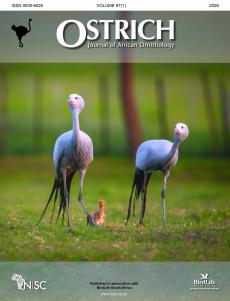
Avian fossils from the Early Miocene Moghra Formation of Egypt
Item type: Journal Article • Journal: Ostrich: Journal of African Ornithology • Authors: N Adam Smith --- National Evolutionary Synthesis Center, USAAvian remains from the Early Miocene (∼17 Ma) Moghra Formation of Egypt include new records of ‘waterbirds’ (storks, herons, pelicans and allies) and a ratite. Only a single avian fossil has been previously reported from Wadi Moghra and, thus, additional... -

Management of avian cholera Pasteurella multocida outbreaks on Dyer Island, South Africa, 2002–2005
Item type: Journal Article • Journal: African Journal of Marine Science • Authors: LJ Waller LG UnderhillIn 2002 there was a widespread epizootic involving seabirds on five of the offshore islands of the Western Cape, South Africa. Since then, avian cholera Pasteurella multocida outbreaks have been occurring annually on one of these islands, Dyer Island. This... -
Vagrant birds ashore at the Prince Edward Islands, southern Indian Ocean, from 1987 to 2009
Item type: Journal Article • Journal: African Journal of Marine Science • Authors: WC Oosthuizen --- Mammal Research Institute, Department of Zoology and Entomology, South Africa BM Dyer --- Department of Environmental Affairs, South Africa PJN de Bruyn --- Mammal Research Institute, Department of Zoology and Entomology, South AfricaVagrant birds recorded ashore at Marion Island and Prince Edward Island from 1987 to 2009 are documented. In total, 101 observations (including multiple sightings of potentially the same individual) of 29 species were made. Palaearctic and Holarctic migrants (17 species),... -
The where, what and how of paediatric central venous access
Item type: Journal Article • Journal: Southern African Journal of Anaesthesia and Analgesia • Authors: RM Gray --- Red Cross Children's Hospital, University of Cape Town,This review aims to help practitioners positioning central venous catheters (CVCs) in paediatric patients to make informed decisions about the site, insertion technique, type of catheter to use, and care of the CVC. -

Avian Flu—What is the risk to humans?
Item type: Journal Article • Journal: South African Family Practice • Authors: Gboyega A Ogunbanjo --- Dept. of Family Medicine & Primary Health Care, -
Breeding ecology of the Seychelles Black Parrot Coracopsis barklyi
Item type: Journal Article • Journal: Ostrich: Journal of African Ornithology • Authors: Anna Reuleaux --- Seychelles Islands Foundation, Seychelles Heather Richards --- Seychelles Islands Foundation, Seychelles Terence Payet --- Seychelles Islands Foundation, Seychelles Pascal Villard --- Seychelles Islands Foundation, Seychelles Matthias Waltert --- Department of Conservation Biology, Germany Nancy Bunbury --- Seychelles Islands Foundation, SeychellesKnowledge of breeding ecology is required for many conservation interventions. The Seychelles Black Parrot Coracopsis barklyi, endemic to the island of Praslin, is vulnerable to extinction. We aimed to improve understanding of C. barklyi breeding ecology to aid conservation planning... -

A comparison of techniques employed in detection of avian malaria infection, South Africa
Item type: Journal Article • Journal: African Zoology • Authors: Sharon Okanga --- Percy FitzPatrick Institute, DST/NRF Centre of Excellence, University of Cape Town, South Africa Graeme S. Cumming --- Percy FitzPatrick Institute, DST/NRF Centre of Excellence, University of Cape Town, South Africa Phillip A. R. Hockey --- Percy FitzPatrick Institute, DST/NRF Centre of Excellence, University of Cape Town, South Africa Mercedes Grome --- Department of Biological Sciences, U.S.A. Jeffrey L. Peters --- Department of Biological Sciences, U.S.A.Avian malaria remains an obscure and mostly unknown avian infection despite the socio-economic threat it poses for poultry industries and its potential to hinder conservation efforts. Therefore, diagnostics for the infection should be expedient, efficient and flexible in applicability. We... -
Temporal and spatial differences in three-egg clutch frequency of the African Black Oystercatcher
Item type: Journal Article • Journal: Ostrich: Journal of African Ornithology • Authors: Dane M Paijmans --- Percy FitzPatrick Institute of African Ornithology, DST–NRF Centre of Excellence, South Africa Douglas Loewenthal --- , Peter G Ryan --- Percy FitzPatrick Institute of African Ornithology, DST–NRF Centre of Excellence, South Africa Philip AR Hockey --- ,African Black Oystercatchers Haematopus moquini produce a modal clutch size of two eggs and only rarely lay three eggs. A review of over 4 000 nest records from across their breeding range (dating back to the early 1960s) revealed that... -
Assessing the threat of avian predation on a small viperid snake
Item type: Journal Article • Journal: African Zoology • Authors: Bryan Maritz --- School of Animal, Plant and Environmental Sciences, South Africa Samantha Scott --- School of Animal, Plant and Environmental Sciences, South AfricaPredators are important because they influence survival rates, population density and behaviour of prey species. However, assessing the predation pressure facing a particular species is difficult when that species faces a suite of predators. We aimed to characterize the suite... -
Seasonality, habitat type and locality influenced bird assemblage structure in Nigeria
Item type: Journal Article • Journal: Ostrich: Journal of African Ornithology • Authors: Sulaiman I Muhammad --- Department of Biological Sciences, Nigeria Rosli Ramli --- Institute of Biological Sciences, Faculty of Science, Malaysia Amy Y Then --- Institute of Biological Sciences, Faculty of Science, MalaysiaThis is the first report of the avian assemblage in the study area of Dutse, Nigeria. In addition to recording bird species, the effects of season, dominant vegetation structure, locality and anthropogenic activities on bird abundance, species richness and diversity... -
Comparison of physiological responses to high temperatures in juvenile and adult Cape Rockjumpers Chaetops frenatus
Item type: Journal Article • Journal: Ostrich: Journal of African Ornithology • Authors: Krista N Oswald --- Department of Zoology, South Africa Alan TK Lee --- Fitzpatrick Institute of African Ornithology, DST/NRF Centre of Excellence, South Africa Ben Smit --- Department of Zoology, South AfricaConcerns about climate change have led to an increase in studies on physiological mechanisms birds possess to cope with increasing temperatures. For range-restricted species such as Cape Rockjumpers Chaetops frenatus, whose population declines are correlated with habitat warming, we identified... -
Taha taha taha: South African bird names across time, language and usage
Item type: Journal Article • Journal: Ostrich: Journal of African Ornithology • Authors: Adrian Koopman --- Faculty of Arts and Design, South Africa Eckhart Buchmann --- School of Clinical Medicine,Humans find birds important as food, symbols, competitors, and objects for amusement or study, and give names to different groups or species of bird. However, a single bird may have many names, likely related to different contexts. This article proposes... -
Summarising biometrics from the SAFRING database for southern African birds
Item type: Journal Article • Journal: Ostrich: Journal of African Ornithology • Authors: Sanjo Rose --- , South Africa Robert L Thomson --- , South Africa Hans-Dieter Oschadleus --- , South Africa Alan TK Lee --- , South AfricaBiometrics form a key characteristic of a species. Here, we provide a summary of biometrics held by the South African Bird Ringing Scheme (SAFRING), which was initiated in 1948, including measures of mass and lengths of the tarsus, head, culmen,... -
New Pleistocene avian ichnosites on South Africa’s Cape south coast
Item type: Journal Article • Journal: Ostrich: Journal of African Ornithology • Authors: Charles W Helm --- Nelson Mandela University, South Africa Martin G Lockley --- University of Colorado Denver, United States Andrew S Carr --- University of Leicester, United Kingdom Hayley C Cawthra --- Nelson Mandela University, South Africa Jan C De Vynck --- Nelson Mandela University, South Africa Mark G Dixon --- Nelson Mandela University, South Africa Pieter-Jan Gräbe --- Nelson Mandela University, South Africa Renée Rust --- Nelson Mandela University, South AfricaTwelve new avian ichnosites have been identified on South Africa’s Cape south coast, adding to the 29 sites previously identified. More than half of these 41 avian ichnosites are found along a 9-km stretch of coastline east of Still Bay... -
Huddling in the heat? Rarely seen thermoregulatory behaviours as Southern Pied Babblers Turdoides bicolor compete for cool microsites
Item type: Journal Article • Journal: Ostrich: Journal of African Ornithology • Authors: Amanda R Bourne --- University of Cape Town, South Africa Camilla Soravia --- The University of Western Australia, AustraliaHuddling is an important thermoregulatory behaviour used by many group-living endotherms to conserve energy during cold weather or periods of food scarcity. It is not typically considered a strategy for keeping cool during hot weather, largely because endotherms produce body... -
Lack of evasive behaviour by a Martial Eagle Polemaetus bellicosus on impact with a turbine blade at a South African wind farm: causes and mitigations
Item type: Journal Article • Journal: Ostrich: Journal of African Ornithology • Authors: Robert E Simmons --- University of Cape Town, South Africa Marlei Martins --- , South AfricaWe describe a collision of Africa’s largest raptor, the Martial Eagle Polemaetus bellicosus with a spinning blade at a South African wind farm in the Eastern Cape in July 2016, and the abandonment of the territory following a second fatal... -
Effects of forest cover and fragmentation on bird functional guilds in understorey birds in shade coffee habitats of southwest Ethiopia
Item type: Journal Article • Journal: Ostrich: Journal of African Ornithology • Authors: Gelaye Gebremichael --- College of Natural Sciences, Jimma University, Ethiopia Anagaw Atickem --- Colleges of Natural Sciences, Addis Ababa University, Ethiopia Seid Tiku Mereta --- Jimma University, Ethiopia Luc Lens --- Ghent University, BelgiumHabitat loss and fragmentation, as consequences of anthropogenic land use changes, are the main drivers of global biodiversity loss. In this study, we evaluate the response of functional guilds in forest understorey bird communities to the amount of forest cover... -
Pleistocene Hamerkop Scopus umbretta (Scopidae) tracks and other new avian ichnosites on South Africa’s Cape south coast
Item type: Journal Article • Journal: Ostrich: Journal of African Ornithology • Authors: Charles W Helm --- Nelson Mandela University, South Africa Given Banda --- Nelson Mandela University, South Africa Andrew S Carr --- University of Leicester, United Kingdom Hayley C Cawthra --- Nelson Mandela University, South Africa Jan C de Vynck --- Nelson Mandela University, South Africa Mark G Dixon --- Nelson Mandela University, South Africa Alex van den Heever --- Magazine Hill, South AfricaEight Pleistocene avian ichnosites have been identified in aeolianites on South Africa’s Cape south coast, adding to the 41 sites previously identified. All the newly identified sites are thought to fall within the age range of marine isotope stages (MIS)...